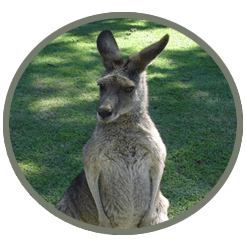
What Do Kangaroos Look Like?
Kangaroos have unique bodies designed for hopping! They have large, powerful hind legs, long feet, a strong tail for balance, and small front legs (arms). This body shape makes them perfect jumpers!
There are four main species of kangaroos:
- Red Kangaroos - Largest, males are reddish-brown, can be 6 feet tall!
- Eastern Grey Kangaroos - Gray fur, common in eastern Australia
- Western Grey Kangaroos - Smaller than Eastern Greys, live in western Australia
- Antilopine Kangaroos - Tan colored, live in northern Australia
Male kangaroos can be HUGE! Large male Red Kangaroos stand over 6 feet tall and weigh up to 200 pounds - heavier than most adult humans! Females are much smaller, usually about half the weight of males.
Female kangaroos have pouches! The pouch is where mothers carry their babies (called joeys). The pouch opens toward the front and has four nipples inside for feeding joeys. Only female kangaroos have pouches - males don't!
Kangaroos have powerful tails! A kangaroo's tail can be 3 feet long and super strong. They use it like a fifth leg for balance and support. When fighting, kangaroos lean back on their tails and kick with both hind legs!
Their hind legs are incredibly muscular! These powerful legs let kangaroos hop 25 feet in a single bound - that's longer than a school bus is wide! They can also jump 6 feet high!
Where Do Kangaroos Live?
Kangaroos live in Australia! They're found across most of the continent, from grasslands to forests to deserts. Different kangaroo species prefer different habitats.
Red Kangaroos love open plains and deserts! They're found in Australia's dry interior. These tough kangaroos can survive in hot, arid conditions where many other animals can't.
Grey Kangaroos prefer forests and grasslands! Eastern Greys live along Australia's east coast where it's wetter. Western Greys live in southern and western Australia in woodlands and shrublands.
Kangaroos live in groups called mobs! A mob can have 10-50 kangaroos or more. Living in groups provides safety - more eyes watching for predators like dingoes, eagles, and crocodiles.
Mobs have a hierarchy! Dominant males (called "boomers") are the strongest and control access to females. Females ("flyers") can live their whole lives in the same mob. Young males leave to find their own mobs when they mature.
Kangaroos are most active at dusk and dawn! They rest during the hottest parts of the day in shade. At twilight, mobs come out to graze when it's cooler. At night, they continue feeding under the stars!
What Do Kangaroos Eat?
Kangaroos are herbivores - they only eat plants! They're grazers that eat mostly grass, but they'll also eat leaves, shrubs, and other vegetation.
What's on a kangaroo's menu?
- Grass (their favorite!)
- Leaves and shoots
- Shrubs and bushes
- Flowers and moss
- Some tree bark
Kangaroos graze like cows! They bite off grass with their front teeth and grind it with their molars. Like cows, kangaroos are ruminants - they have special stomachs that help digest tough plant material.
Kangaroos can go without water for long periods! In dry areas, they get most of their water from plants they eat. When water is available, they drink, but they can survive weeks without drinking if needed!
They're adapted for Australia's harsh conditions! When food is scarce during droughts, kangaroos can slow down their digestion to get more nutrients from less food. This helps them survive when times are tough!
Kangaroos feed mostly at night! They graze in the cooler evening and early morning hours. During hot days, they rest in shade to conserve energy and stay cool.
Competition with sheep and cattle! Since kangaroos eat grass like livestock, farmers sometimes see them as competitors for grazing land. This has led to conflicts between kangaroos and agriculture.
Baby Kangaroos
Baby kangaroos are called joeys. Female kangaroos are pregnant for only 30-40 days - one of the shortest pregnancies of any mammal!
Joeys are born incredibly tiny and undeveloped! At birth, a joey is only about 1 inch long, weighs less than 1 gram, is blind, hairless, and has no ears. It looks like a tiny pink bean!
The joey makes an amazing journey! Using its front legs (the only developed part), the tiny joey crawls from the birth opening, through mom's fur, and up into her pouch - all on its own! This 6-inch journey takes about 3 minutes. It's like a human baby crawling a mile!
Once in the pouch, the joey latches onto a nipple! It stays attached for weeks, drinking milk and growing. The nipple swells in the joey's mouth so it can't fall off. The pouch stays closed to keep the baby safe and warm.
Joeys stay in the pouch for 6-8 months! At first, they're permanently attached to the nipple. Around 4 months, they start peeking out. By 6 months, they begin leaving the pouch for short periods but always return.
Young joeys explore but stay close to mom! Between 8-11 months, joeys leave the pouch for good but continue nursing by sticking their heads into the pouch. They follow mom everywhere, learning what to eat and how to stay safe.
Joeys are playful! Young kangaroos hop, wrestle, and play-fight. This play helps them build strength and coordination they'll need as adults. It's adorable to watch!
Young kangaroos are vulnerable! Eagles, dingoes, foxes, and feral cats hunt joeys. Mothers defend their babies fiercely, but many joeys don't survive to adulthood. Those that do usually live 8-23 years depending on the species.
Why Are Kangaroos Special?
Kangaroos are designed with unique adaptations! Their hopping locomotion, pouches, and ability to pause pregnancies make them unlike any other animal. They're perfectly suited for Australia's challenging environment!
Kangaroos are important for Australian ecosystems! As grazers, they help control grass growth and maintain open habitats. Many native plants and animals depend on the landscapes shaped by kangaroo grazing.
Kangaroos are Australia's national symbol! They appear on Australia's coat of arms, coins, and are recognized worldwide as symbols of Australia. They represent the uniqueness of Australian wildlife.
Kangaroo populations are generally healthy! Unlike many large mammals, most kangaroo species have stable or growing populations. This success shows what's possible when we protect wildlife and their habitats. By valuing and protecting kangaroos, we celebrate the amazing diversity of life on Earth!