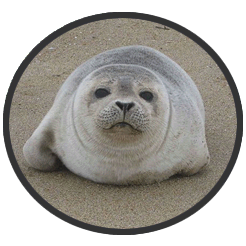
What Do Seals Look Like?
All pinnipeds have streamlined bodies perfect for swimming and flippers instead of regular limbs! But there are three main groups with different features.
True Seals (Earless Seals):
- No external ear flaps (just ear holes)
- Short front flippers
- Can't rotate hind flippers forward
- Move on land by wiggling like caterpillars
- Examples: Harbor seals, elephant seals, leopard seals, monk seals
- 18 species total
Sea Lions & Fur Seals (Eared Seals):
- Small external ear flaps visible
- Large front flippers
- Can rotate hind flippers forward
- Walk on land using all four flippers
- Examples: California sea lions, Steller sea lions, fur seals
- 14 species total
Walruses:
- Massive tusks (can be 3 feet long!)
- Thick, wrinkled skin
- Mustache of 400-700 sensitive whiskers
- Can weigh 1,500-4,000 pounds
- Can rotate hind flippers like sea lions
- Only 1 species
Pinniped sizes vary dramatically! The smallest is the Ringed Seal at 3-4 feet long and 110 pounds. The largest is the Southern Elephant Seal - males can reach 20 feet and weigh 4,400 pounds - heavier than a car!
Pinnipeds have thick blubber! This fat layer keeps them warm in cold ocean water. Blubber can be 2-6 inches thick! It also helps them float and stores energy. Baby seals often have extra-thick blubber to stay warm.
Many seals have beautiful spotted patterns! Harbor seals have gray, brown, or tan coats with dark spots. Leopard seals have spotted throats. Some seals change color seasonally - darker in summer, lighter in winter.
Whiskers are super sensitive! Seals have long whiskers (vibrissae) on their faces. These detect vibrations in water, helping seals find fish in murky or dark water. Blindfolded seals can still catch fish using whiskers alone!
Where Do Seals Live?
Pinnipeds live in all the world's oceans! They're found from tropical waters to icy Arctic and Antarctic seas. Most live in coastal areas, but some venture far offshore.
Many seals prefer cold waters! Arctic seals like ringed, bearded, and harp seals live among sea ice. Weddell seals live in Antarctica - farther south than any other mammal! Cold-water seals have extra-thick blubber for insulation.
Some seals live in warm climates! Hawaiian monk seals live in tropical Pacific waters. California sea lions thrive along the Pacific coast. Galápagos fur seals live near the equator! These seals have thinner blubber and need shade to cool down.
Pinnipeds need land for breeding! They come ashore on beaches, rocky shores, or ice floes to give birth and raise pups. Some colonies have thousands of seals packed together! These breeding areas are called rookeries or haulouts.
Walruses live in Arctic waters! They haul out on sea ice or rocky beaches in massive groups - sometimes 1,000+ walruses together! Males use their tusks to pull themselves onto ice (the name "walrus" means "tooth walker"). Walruses rarely venture far from coastlines.
Elephant seals dive incredibly deep! They can dive over 5,000 feet down - deeper than any other seal! They spend 90% of their lives at sea, coming to land only to breed and molt. Northern elephant seals migrate between California beaches and feeding areas near Alaska.
Some seals live in freshwater! Lake Baikal in Russia has the only freshwater seal - the Baikal seal. These seals are landlocked and never see the ocean! A few other seal species occasionally venture into rivers.
Leopard seals are Antarctic predators! They live on pack ice and hunt penguins, other seals, and fish. Leopard seals are solitary and patrol ice edges waiting for prey. They're among the most fearsome predators in Antarctica!
What Do Seals Eat?
All pinnipeds are carnivores! They eat fish, squid, octopus, shellfish, and some hunt other marine mammals.
Most seals eat fish:
- Salmon, herring, mackerel, cod
- Each seal can eat 5-10% of body weight daily
- Harbor seals eat 15-20 pounds of fish per day
- They swallow small fish whole underwater
- Larger fish are brought to surface and torn apart
Many also eat squid and octopus:
- Squid are a favorite food for many species
- Elephant seals eat mostly squid in deep water
- Octopus are hunted by some coastal seals
Some eat shellfish:
- Walruses eat clams, mussels, snails, and worms
- They use sensitive whiskers to find shellfish buried in seafloor mud
- Walruses suck meat out of shells (don't eat shells)
- One walrus can eat 3,000-6,000 clams in one feeding!
A few hunt other animals:
- Leopard seals hunt penguins, other seals, and fish
- They wait near penguin colonies and grab penguins entering water
- Large male leopard seals can eat crabeater seal pups
- Some walruses occasionally eat seabirds or seals
Seals are excellent hunters! They use sensitive whiskers to detect fish movements in dark or murky water. Their large eyes see well in dim light. Some seals dive over 1,000 feet deep to catch fish. They can hold their breath for 20 minutes to 2 hours depending on species!
Elephant seals are deep-diving champions! They routinely dive 1,000-5,000 feet down to hunt deep-sea squid and fish. They can hold their breath for up to 2 hours! They spend very little time at the surface - just a few minutes to breathe before diving again.
Sea lions are cooperative hunters! California sea lions sometimes hunt in groups, herding fish into tight balls. Then individuals take turns rushing through to catch fish. Teamwork helps them catch more food!
Seals don't chew food! They have sharp teeth for grabbing prey but swallow fish whole or tear them into chunks. Their powerful digestive systems break down bones, scales, and all. Some seals swallow stones (gastroliths) which might help digestion or diving.
Baby Seals
Baby seals are called pups! Pinniped mothers give birth to one pup per year (twins are extremely rare).
Pups are born on land or ice! Most seals come ashore to give birth. Mothers search for safe beaches, rocky shores, or ice floes away from predators. Some species form huge colonies with thousands of mothers and pups together!
Seal pups are born ready! Most can swim within hours of birth. They're born with thick fur (though it might not be waterproof initially). Pups have large eyes and can see from birth. They vocalize to call for mom!
Mothers recognize pups by voice and smell! In crowded colonies with thousands of seals, mothers find their specific pups using unique vocalizations and scent. Pups call when hungry, and mothers respond only to their own pup's voice!
Nursing varies by species! Harbor seals nurse for 3-4 weeks. Elephant seals nurse for only 3-4 weeks but gain 300+ pounds in that time! Walruses nurse for 2 years - one of the longest nursing periods of any mammal. Seal milk is extremely rich and fatty!
Pups grow incredibly fast! Elephant seal pups are born at 75 pounds. After 4 weeks of nursing, they weigh 300-400 pounds! Mother elephant seals don't eat during this time - they lose 600+ pounds while nursing. It's an exhausting maternal sacrifice!
Some mothers abandon pups suddenly! Elephant seal and hooded seal mothers nurse intensively for a few weeks, then abruptly leave. Pups (called weaners) must survive on stored blubber for weeks or months before learning to hunt. Many don't survive this vulnerable period.
Sea lion mothers are more attentive! Female sea lions nurse pups for 6-12 months. Mothers alternate between feeding at sea and nursing on land. Pups gradually learn to swim and hunt alongside mom. They stay with mothers much longer than true seals.
Pups face many dangers! Sharks, killer whales, and polar bears hunt seal pups. Storms can wash pups out to sea. Starvation threatens pups whose mothers die. Only about 50% of pups survive their first year. Those that survive can live 15-40 years!
Why Are Seals Special?
Pinnipeds are designed with remarkable adaptations! Their streamlined bodies, ability to hold breath for hours, deep-diving capabilities, and sensitive whiskers make them supreme ocean hunters. They've successfully adapted from land mammals to marine life!
Seals are crucial for ocean ecosystems! As predators, they control fish populations. As prey, they feed sharks, killer whales, and polar bears. Pinnipeds are vital links in ocean food chains. Their presence indicates healthy marine ecosystems!
Seals help humans! Historically, seals provided food, oil, and fur for Arctic peoples. Scientists study seals to understand ocean health. Seal diving abilities inspire submarine and diving suit technology. Watching wild seals brings joy to millions!
Some seal species are threatened! Overhunting nearly drove many species extinct. Monk seals, ribbon seals, and some fur seals are endangered. Ocean pollution and fishing net entanglement threaten seals. Conservation efforts have helped many populations recover!
Everyone can help seals! Support marine protected areas. Reduce plastic use (prevents ocean pollution). Choose sustainable seafood (protects fish seals eat). Report injured seals to marine mammal rescue. Never disturb seals on beaches - they need rest! Small actions protect these amazing animals!