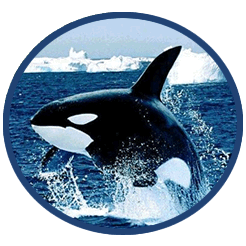
What Do Whales Look Like?
Whales are ENORMOUS! The Blue Whale is the largest animal ever - bigger than any dinosaur! Blue Whales can be 100 feet long and weigh 200 tons - that's as heavy as 33 elephants or 2,000 people! Even small whales like Minke Whales are 30 feet long.
There are two main types of whales! Baleen whales have plates called baleen instead of teeth. Toothed whales have teeth for catching prey. This might seem like a small difference, but it changes everything about how they eat!
Baleen whales include:
- Blue Whales (biggest animal ever!)
- Humpback Whales (famous singers)
- Gray Whales
- Right Whales
Toothed whales include:
- Sperm Whales (biggest toothed whales)
- Orcas/Killer Whales (actually dolphins!)
- Belugas (white whales)
- Narwhals (the "unicorns of the sea")
Whales have streamlined bodies! Their smooth, torpedo-shaped bodies help them glide through water. Most whales are dark on top and lighter underneath - this counter-shading helps them hide from predators and prey.
Whales have blowholes for breathing! These are like nostrils on top of their heads. When whales surface, they exhale forcefully through their blowholes, creating a spray called a "blow" or "spout." Baleen whales have two blowholes; toothed whales have one!
Their tails are called flukes! Whale flukes are horizontal (flat like a table), not vertical like fish tails. Whales pump their flukes up and down to swim - this powerful motion pushes them through the ocean at high speeds!
Where Do Whales Live?
Whales live in oceans all around the world! Different whale species prefer different waters - some like cold polar seas, others prefer warm tropical oceans, and some travel between both!
Many whales migrate! Humpback Whales travel up to 16,000 miles each year - that's more than halfway around Earth! They spend summers feeding in cold waters near the poles, then swim to warm tropical waters for winter to have babies.
Some whales live in polar waters! Bowhead Whales spend their whole lives in Arctic waters. Belugas love cold water too. These whales have thick blubber (fat) layers up to 12 inches thick to stay warm!
Other whales prefer warm waters! Bryde's Whales stay in tropical and subtropical oceans year-round. They don't need to migrate because their food is available all year in warm waters.
Whales travel in groups called pods! Some pods have just a few whales (mother and calf), while others have dozens. Whales in a pod communicate, hunt together, and protect each other.
Whales can dive DEEP! Sperm Whales dive over 3,000 feet deep - that's deeper than 10 football fields stacked up! They can hold their breath for over an hour! Cuvier's Beaked Whales have been recorded diving almost 10,000 feet deep!
What Do Whales Eat?
Different whales eat different things! Their diet depends on whether they have teeth or baleen.
Baleen whales eat tiny animals! Despite being huge, baleen whales eat some of the smallest ocean creatures:
- Krill (tiny shrimp-like animals)
- Small fish (herring, sardines)
- Plankton and copepods
How do baleen whales eat? They take enormous gulps of water full of krill or fish. Then they push the water out through their baleen plates (which work like a strainer), trapping the food inside! Some baleen whales can eat 4 tons of krill per day - that's 8,000 pounds!
Some baleen whales "lunge feed"! Humpback Whales charge into schools of fish with their mouths wide open, gulping huge amounts. Blue Whales can take in enough water to fill a school bus in one gulp!
Others bubble-net feed! Humpback Whales blow bubbles in a circle around fish, creating a "net" that traps them. Then all the whales swim up through the middle with mouths open, catching tons of fish!
Toothed whales hunt larger prey:
- Sperm Whales eat giant squid!
- Orcas hunt fish, seals, and even other whales
- Belugas eat fish and octopuses
Sperm Whales dive deep to hunt giant squid! These battles in the dark ocean depths are epic. Sperm Whales often have scars from squid suckers on their skin.
Whales don't drink seawater! Like dolphins, whales get water from their food. Fish and krill contain freshwater that provides all the hydration whales need.
Baby Whales
Baby whales are called calves. Mother whales are pregnant for 10-17 months, depending on the species. Most whales have one calf at a time.
Whale calves are born HUGE! Even the smallest whale calves are 6-10 feet long at birth. Blue Whale calves are 25 feet long and weigh 3 tons - already the size of an adult elephant!
Calves are born tail-first! This prevents them from drowning. As soon as the baby is born, mom or another whale helps push it to the surface for its first breath.
Baby whales can swim immediately! Within minutes of birth, calves swim beside their mothers. They need to - whales must keep moving to stay afloat and breathe!
Whale milk is super rich! It's 10 times fattier than human milk - almost like drinking cream! This rich milk helps calves grow incredibly fast. Blue Whale calves gain 200 pounds every day for their first year!
Calves nurse underwater! Mom squirts milk into the calf's mouth. Calves nurse for 6-12 months, though some continue nursing while also eating solid food for 2 years!
Mother whales are very protective! Moms keep calves close, helping them breathe, teaching them to dive, and protecting them from predators. In some whale species, other females help watch and care for calves too.
Young whales stay with mom for years! Depending on the species, calves stay with their mothers for 1-3 years. During this time, they learn migration routes, feeding areas, and how to communicate and behave with other whales.
Why Are Whales Special?
Whales are designed as remarkable ocean giants! Their size, intelligence, and adaptations make them some of nature's most impressive creatures. From the largest animal ever (Blue Whale) to the deepest-diving mammals (Sperm Whales and Beaked Whales), whales push the limits of what's possible!
Whales are important for ocean health! Their poop fertilizes the ocean, helping tiny plankton grow. When whales die, their massive bodies sink to the ocean floor, providing food for deep-sea creatures for decades. Healthy whale populations mean healthy oceans!
Sadly, many whales were hunted until recently! Commercial whaling nearly drove some species extinct. Blue Whales, Right Whales, and others were hunted for their oil and meat. Now most whaling has stopped, and whale populations are slowly recovering.
Whales still face threats! Ship strikes, fishing net entanglement, ocean pollution, and noise pollution endanger whales. Many organizations work to protect whales through research, rescue, and conservation. By protecting oceans, we help whales and all marine life!